




Introduction: The End of Small-Capital Trading and the Rise of a Skill-Based Era
The financial markets have always operated under one unwritten yet unforgiving rule: money makes money.
For years, talented traders with limited capital have remained trapped behind the high barriers to professional trading. The story is painfully familiar for many Iranian traders: they spend months learning technical analysis and price action, only to enter the market with a $500 or $1,000 account when it is finally time to trade.
What happens next?
Even if they generate a remarkable monthly return of 10%, their profit may amount to only $50 or $100. That may not even cover basic living expenses or the cost of professional trading tools.
The pressure to earn more then pushes traders to increase their position sizes beyond reasonable limits—and that is often where the collapse begins. The account is eventually liquidated or reaches a margin call, not because the trader lacks knowledge, but because they lack sufficient capital.
In recent years, however, the financial markets have changed dramatically. The rise of the proprietary trading industry has transformed the rules of the game.
You no longer need to come from a wealthy family or spend years saving money to access $10,000 or $50,000 in trading capital. Today, your skill can become your most valuable currency.
This article is not merely a guide. It is a comprehensive written training course designed to explain the prop trading industry in depth.
At MyProp, as one of the pioneers of this industry in Iran, we have brought together our knowledge, experience, and practical insights to create a detailed reference for traders.
If you are ready to move from being a retail trader to becoming a professional capital manager, this article is for you.
Chapter One: An In-Depth Breakdown of Prop Trading
1.1 Academic and Practical Definition
In traditional financial terminology, proprietary trading occurs when a financial institution—such as a bank, hedge fund, or investment company—trades using its own capital to generate direct profits rather than earning commissions from clients.
The modern model discussed in this article is generally referred to as retail prop trading.
It can be defined as:
A process in which a private company provides independent remote traders with capital, infrastructure, and risk-management systems and, in return, pays the trader an agreed share of the profits.
This model creates a classic win-win relationship.
For the trader
Access to substantial trading capital without placing an equivalent amount of personal money at risk.
For the company
Access to the skills and trading intelligence of thousands of independent traders without having to employ them as traditional staff members.
1.2 The Evolution of Prop Trading: From Chicago Trading Pits to Remote Traders in Tehran
To understand the future of proprietary trading, we must first examine its history.
The First Generation: The Trading Floor Era
Before financial markets became fully digital, proprietary traders worked inside the trading pits of exchanges in Chicago and New York.
They were employees of financial institutions, received salaries, and executed trades directly on the exchange floor.
The Second Generation: The Arcade Era
In the late 1990s, trading companies in London and New York began opening physical trading arcades.
Traders were required to deposit substantial amounts of capital and work from the company’s office.
The Third Generation: The Remote Trading Era
After the 2008 financial crisis and the introduction of stricter banking regulations, including the Volcker Rule, many banks shut down or reduced their proprietary trading divisions.
As a result, experienced traders began establishing independent private trading firms.
The Fourth Generation: The Online Evaluation Era
The current model is based on online trader evaluation.
FTMO helped popularize this approach in 2015, and companies such as MyProp have since adapted it to meet the needs of local markets.
In this model, online trading performance replaces traditional résumés and job interviews.
It is a highly merit-based system: your performance record becomes your primary qualification.
1.3 How Prop Firms Make Money
Critics sometimes ask:
“Why would a company provide traders with capital for free?”
The answer is simple: prop firms are commercial businesses, not charities.
They generally operate through several revenue streams.
A. Evaluation Fees
The evaluation fee functions similarly to the fee charged for a university entrance examination or an international language test.
Traders pay to participate in a challenge, and this payment helps cover the cost of:
- Trading infrastructure
- Servers and technology
- Risk-management systems
- Customer support
- Operational expenses
A large percentage of participants do not successfully complete the evaluation, and these fees may contribute to the company’s overall liquidity and operating revenue.
B. Profit Sharing
When a trader generates profit on a funded account, the firm retains an agreed percentage.
For example, if a trader generates $10,000 in profit and the company’s share is 20%, the firm receives $2,000.
When hundreds of consistently profitable traders operate within the same firm, this revenue stream can become substantial.
C. Trade Replication and Performance Data
Some larger firms identify their most successful traders and replicate their trades on live brokerage or liquidity-provider accounts.
For example, a trader may open a one-lot position on gold. If the company’s risk system identifies that trader as consistently profitable, the firm may replicate the same position at a significantly larger scale on its own account.
The trader receives the profit share defined by the agreement, while the firm may generate additional returns from the replicated position.
Chapter Two: Independent Trader or Prop Trader?
Choosing between trading through a personal brokerage account and joining a prop firm is one of the most important decisions a trader can make.
The two models should be compared from several perspectives.
2.1 Risk-to-Reward Analysis
In personal trading, the basic formula is:
Profit = Personal Capital × Return Percentage
In prop trading, the simplified formula is:
Profit = Company Capital × Return Percentage × Trader’s Profit Share − Challenge Fee
Numerical Example
Assume you have $500 available.
Personal-account route
You deposit the full $500 into a brokerage account.
If you make a 10% return, you earn $50.
If you lose 10%, your balance falls to $450.
Your full $500 is exposed to market risk.
Prop-trading route
You use $300 to purchase access to a $50,000 MyProp challenge and retain the remaining $200.
If you pass the challenge and generate a 10% return during the first month:
- Gross profit: $5,000
- Trader’s share at 80%: $4,000
In this example, you have used less personal capital while gaining access to a much larger potential return.
Naturally, this outcome depends on successfully completing the challenge, following all rules, and generating the assumed return.
2.2 The Psychology of Having “Skin in the Game”
When traders lose money in a personal account, the emotional pain of watching their own capital decline may lead to irrational decisions such as:
- Adding to losing positions
- Removing stop-loss orders
- Increasing position sizes
- Revenge trading
The psychological pressure is different in a prop account because the trading capital does not belong directly to the trader.
Instead of worrying about losing the entire principal, the trader is primarily focused on staying within the firm’s rules.
This structure may help some traders make more objective decisions, provided they have the discipline required to respect the account limits.
2.3 The Growth Curve
Growing a small personal account through compound returns can take years.
For example, turning a $1,000 account into $10,000 through controlled and consistent trading may require a considerable amount of time.
A prop firm’s scaling plan may offer a faster route.
At MyProp, consistently profitable traders may become eligible for capital increases based on their performance and the conditions of the relevant plan.
A trader may gradually progress from managing a $10,000 account to significantly larger allocations, potentially reaching $200,000, $500,000, or more.
This type of capital expansion is extremely difficult to achieve through a small personal account alone.
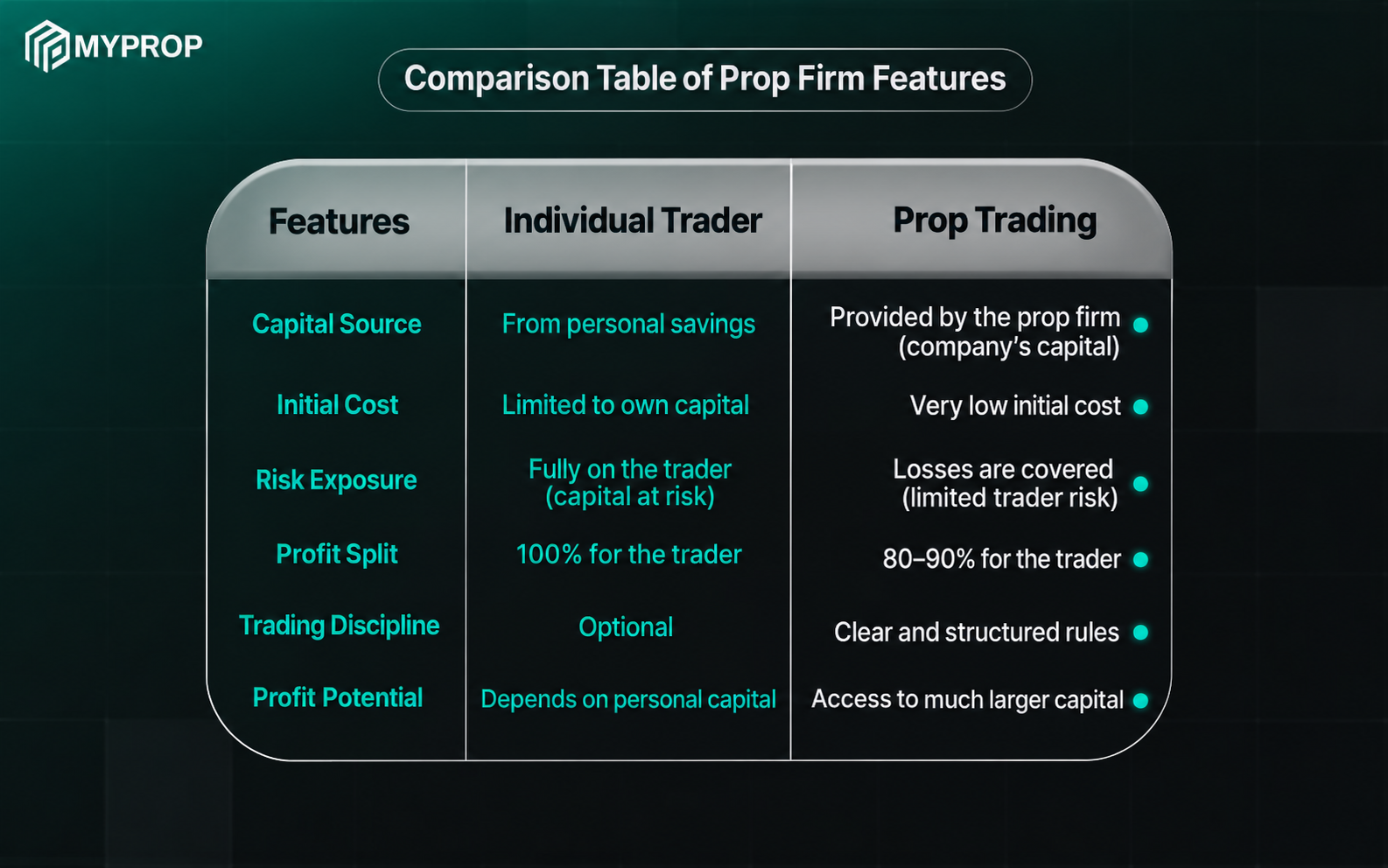
Comparison Table: Prop Trading vs. Personal Trading
Chapter Three: Understanding Prop Trading Rules and Terminology
This chapter may appear less exciting than the others, but many challenge failures occur because traders do not fully understand the rules.
Reading the rules once is not enough. Traders must understand the mathematical logic behind them.
3.1 Drawdown: The Silent Threat
Drawdown does not simply mean a loss.
It refers to the decline from a previous peak in account value.
A. Daily Drawdown
The daily drawdown rule is designed to prevent excessive or gambling-like risk during a single trading day.
A typical rule may limit the trader’s daily loss to 5% of the starting balance or equity, depending on the account model.
Equity Trap Scenario
Assume you begin the day with a $100,000 account.
Your daily loss limit is $5,000, meaning the account must not fall below $95,000.
You open a position that moves $3,000 into profit, increasing your equity to $103,000, but you do not close it. The market then reverses.
Does your daily loss threshold remain at $95,000?
The answer depends on the firm’s calculation method.
Balance-based model
The daily limit is calculated using the starting balance and does not become tighter because of unrealized profits.
Equity-based or trailing model
The loss limit may move based on changes in equity, including unrealized profits.
MyProp uses clearly defined balance-based or equity-based models depending on the selected plan. Traders should always review the latest rules for their specific account.
B. Maximum Drawdown: Static or Trailing
Static drawdown
The maximum loss threshold remains fixed.
For example, on a $100,000 account, the threshold may remain at $88,000 regardless of account growth.
This model is generally more flexible for traders.
Trailing drawdown
The loss threshold rises as the account grows.
For example, if the account increases from $100,000 to $105,000, the maximum loss threshold may also rise from $88,000 to $93,000.
This model is more restrictive because previously earned profits may reduce the remaining loss allowance.
3.2 Time and News-Trading Restrictions
Minimum trading days
Some challenges require traders to trade on a minimum number of separate days.
The purpose is to prevent a trader from passing the evaluation through one unusually large or lucky trade.
News trading
Whether news trading is allowed depends on the prop firm and the selected plan.
It may be permitted during the evaluation phase, while some firms restrict trading shortly before and after high-impact economic announcements on funded accounts.
These restrictions exist because major news events can cause:
- Extreme volatility
- Slippage
- Wide spreads
- Execution problems
- Increased risk for the firm
Traders must review the exact news-trading rules applicable to their account.
3.3 Position-Size Consistency
Some prop firms evaluate whether a trader’s position sizes remain reasonably consistent.
A trader who normally uses one-lot positions but suddenly opens a ten-lot trade to pass the challenge may be considered to be displaying gambling-like behavior.
MyProp evaluates trading consistency and risk-management patterns.
Even a profitable account may be reviewed if the trader’s behavior appears excessively risky or inconsistent with responsible capital management.
Chapter Four: The Psychology of Prop Trading

Technical and fundamental analysis are the hardware of trading; psychology is the operating system.
Even the most powerful computer cannot function effectively with a corrupted operating system.
The psychological pressures of prop trading differ from those experienced in a personal account.
4.1 Prop-Specific Psychological Biases
A. The House Money Effect
The house money effect is a well-known concept in behavioral economics.
People may take greater risks when they feel they are using money they did not personally earn, such as prize money or company-funded capital.
A common warning sign is the thought:
“It is not my money, so I might as well use maximum margin and see whether I pass.”
The solution is to treat the prop account as though it represents years of your personal savings.
Every dollar of drawdown should be viewed as a real reduction in your professional credibility and available risk capacity.
B. Performance Anxiety
In a personal account, traders may feel that nobody is monitoring them.
In a prop account, the dashboard records detailed statistics such as:
- Win rate
- Drawdown
- Average profit
- Average loss
- Trading frequency
- Position duration
The feeling of being constantly evaluated can lead to analysis paralysis.
A practical solution is to check the dashboard only at predetermined times and focus on the quality of execution rather than the account’s profit figure after every trade.
C. Deadline Syndrome
In time-limited challenges, traders may become increasingly aggressive as the deadline approaches.
This often leads to oversized trades and poor decisions during the final days of the evaluation.
Although many MyProp challenges do not impose a time limit, traders should still avoid creating artificial deadlines for themselves.
4.2 The Emotional Cycle of a Prop Trader
A typical emotional cycle may look like this:
- Purchasing the challenge: excitement, hope, and a surge of motivation
- The first loss: denial and the belief that it can be recovered quickly
- The second or third loss: fear and doubt about the strategy
- Attempting to recover: larger positions and revenge trading
- Violating the drawdown rule: anger and disappointment
- Acceptance: returning to practice or purchasing another challenge
The objective is to interrupt this cycle before the revenge-trading stage.
When an account enters a noticeable drawdown, the trader should usually reduce risk—not increase it.
Chapter Five: Trading Strategy and Risk Management
Passing a prop challenge does not require an unnecessarily complicated strategy.
It requires disciplined execution and sound mathematics.
5.1 The Position-Sizing Formula
Position size should never be chosen randomly.
It should be calculated according to:
- Account balance
- Risk percentage
- Stop-loss distance
- Pip or point value
A simplified formula is:
Position Size = (Account Balance × Risk Percentage) ÷ (Stop-Loss Distance × Pip Value)
Example
Assume:
- Account balance: $10,000
- Risk per trade: 1%, or $100
- Stop-loss distance: 20 pips
- Pip value for one standard lot: $10
The calculation is:
Position Size = 100 ÷ (20 × 10) = 0.5 lots
If the stop-loss distance increases to 50 pips, the position size should decrease to 0.2 lots.
Using this approach, the financial loss remains approximately $100 whether the stop-loss is 20 or 50 pips away.
Traders must remember that pip and point values vary between instruments, particularly for gold, indices, currencies, and different contract specifications.
5.2 The Buffer Strategy
At the beginning of a challenge, the first objective should not necessarily be rapid profit.
The first objective should be to create a safety margin.
Phase One: Building security
Use relatively low risk, such as 0.25% or 0.5% per trade, until the account is approximately 1% to 2% in profit.
Phase Two: Controlled growth
Once the account has a positive buffer, risk may be returned to the trader’s normal predetermined level.
The logic is psychological as well as mathematical.
If the trader loses 1% after building a 2% profit buffer, the account remains positive.
By contrast, losing 1% on the first day may immediately create pressure to recover the loss.
5.3 Managing Drawdown With the Three-Bullet Rule
Under the three-bullet rule, the trader allows a maximum of three losing attempts per day.
For example:
- First trade: 0.5% loss
- Second trade: 0.5% loss
- Third trade: 0.5% loss
Total daily loss: 1.5%
Trading then stops until the next day.
This rule provides two important benefits:
- It prevents the trader from approaching a 5% daily loss limit.
- It reduces the risk of revenge trading.
Three consecutive losses may indicate that the market conditions are unsuitable for the strategy or that the trader is not in the right mental state to continue.
Chapter Six: Legal, Tax, and Religious Considerations for Iranian Traders
Participating in international financial markets has always involved uncertainty for Iranian users.
The following points should be considered carefully.
6.1 Sanctions and Identity Verification
Many international prop firms explicitly restrict access for residents or citizens of sanctioned countries.
Using false identification, fabricated addresses, or an overseas VPS to bypass these restrictions carries significant risk.
A trader may pass the evaluation and become profitable, only to face secondary identity checks during the payout process.
If the company discovers false information or an undisclosed location, it may close the account and withhold the payout according to its terms.
MyProp’s infrastructure is designed for Persian-speaking and regional users and allows eligible traders to complete the KYC process using accepted Iranian identification documents.
This removes much of the uncertainty associated with hiding nationality or location.
6.2 Taxation of Prop Trading Income in Iran

Tax treatment may depend on factors such as:
- The amount of income
- The payment method
- The frequency of transactions
- Whether trading is treated as an ongoing professional activity
- Current Iranian tax regulations
Income received through cryptocurrency and converted through informal or decentralized channels may not currently be subject to the same monitoring mechanisms as large bank transfers.
However, substantial and frequent deposits into an Iranian bank account may attract scrutiny and could potentially be treated as business or professional income.
Traders earning significant amounts should consult a qualified Iranian tax adviser and maintain clear records of their income and transactions.
Tax regulations may change, so no article should be treated as a substitute for professional legal or tax advice.
6.3 Islamic Considerations
Muslim traders commonly consider two major issues.
Overnight swap
Forex positions held overnight may incur or earn swap charges.
Some religious interpretations consider interest-based swap payments problematic.
Swap-free or Islamic accounts may remove overnight interest, although the broker or provider may apply a different commission structure.
Futures and CFD trading
Religious opinions differ regarding derivatives, futures, and CFDs, particularly where no physical delivery of an underlying asset occurs.
Some scholars consider these structures problematic, while others may permit certain arrangements under specific contractual interpretations.
Traders should consult their own religious authority regarding the permissibility of the instruments and account structures they intend to use.
Chapter Seven: MyProp—More Than a Prop Firm
At MyProp, we do not view ourselves solely as a challenge provider.
Our objective is to build a broader trader-development ecosystem.
7.1 Challenge Insurance
Challenge insurance is designed to reduce the financial pressure associated with losing an evaluation account.
Depending on the applicable plan and insurance conditions, a trader may receive:
- A replacement challenge
- A discounted new account
- An account reset
- Another recovery benefit
The insurance applies only under the specific rules of the selected account.
It does not protect traders who engage in fraud, prohibited strategies, abusive execution methods, or deliberate violations of core risk rules.
The main benefit is psychological: reducing the fear that a single evaluation failure will permanently eliminate the amount paid for the challenge.
However, insurance should never be treated as permission to trade irresponsibly.
7.2 Professional Analytics Dashboard
A professional trading dashboard should provide more than a balance figure.
MyProp’s analytical tools may help traders examine areas such as:
- Profit and loss by time of day
- Performance by trading instrument
- Average winning and losing trades
- Drawdown patterns
- Risk exposure
- Proximity to account limits
For example, a trader may discover that they consistently lose money when trading gold but perform well on EUR/USD.
Another trader may learn that most of their losses occur after a specific hour.
This type of data can turn the dashboard into a decision-making tool rather than a simple account monitor.
7.3 Scaling Plan
The objective is not for successful traders to remain permanently at the same account size.
Depending on the rules of the selected plan, traders who demonstrate consistent profitability and responsible drawdown management may become eligible for increased capital.
The scaling process may continue until the trader reaches a significantly larger allocation.
The specific percentage increases, performance requirements, and maximum account size should always be checked in the latest official MyProp rules.
Chapter Eight: The Future of Prop Trading, 2026–2030
The prop trading industry continues to evolve rapidly.
What exists today may represent only an early stage of a much larger ecosystem.
8.1 Artificial Intelligence in Evaluation and Coaching
Traditional trader evaluation has mostly relied on fixed rules such as a 5% daily drawdown limit.
Future generations of prop firms may increasingly use behavioral evaluation.
AI-driven systems may analyze:
- Trading times
- Reaction speed
- Position duration
- Behavior while a trade is losing
- Changes in position size
- Emotional patterns reflected in execution
- Repeated mistakes
Instead of informing traders only after they have failed, an intelligent coaching system could issue real-time warnings.
For example:
“Your historical performance declines significantly after 6:00 p.m. Consider ending your trading session for today.”
This would move prop trading from simple rule enforcement toward data-driven trader development.
8.2 Integration With DeFi and Tokenization
Blockchain technology may introduce greater transparency and automation into the industry.
Possible developments include:
Faster payouts
Smart contracts could automatically distribute a trader’s profit share once the relevant conditions have been verified.
Proof of reserves
Prop firms may publish verifiable blockchain-based evidence showing that they hold sufficient capital or liquidity.
Tokenized trading programs
Some firms may create tokenized systems for funding, rewards, or trader performance records.
These developments remain dependent on regulation, security, and practical adoption.
8.3 The Growth of Specialized Prop Firms

The one-size-fits-all model may gradually become less common.
More specialized firms may emerge, including:
- Crypto-focused prop firms with rules adapted to Bitcoin volatility
- Algorithmic trading firms for traders using expert advisers and automated systems
- Swing-trading firms without restrictive daily drawdown structures
- Firms that allow weekend position holding
- Firms focused on specific instruments or regions
Specialization may allow firms to design evaluation rules that better match each trading style.
Chapter Nine: A Practical Action Plan From Beginner to First Payout
Reading alone is not enough.
Knowledge without action may create only the illusion of progress.
The following ten-step roadmap provides a practical structure.
Phase One: Preparation
1. Develop your skills
Spend sufficient time learning technical, fundamental, or quantitative analysis.
Do not enter a prop challenge without a written trading plan.
2. Test the strategy
Test your strategy in a demo environment using rules similar to those of a prop account.
Ask yourself:
- Has the strategy been profitable over several months?
- What is its average drawdown?
- How many consecutive losses can it experience?
- Does it remain valid in different market conditions?
3. Evaluate the prop firm
Before purchasing a challenge, review:
- Rules
- Reputation
- Payout process
- Customer support
- KYC requirements
- Payment methods
- Restrictions for Iranian users
Phase Two: Entering the Challenge
4. Choose a suitable account
Select an account whose challenge fee does not create severe financial pressure.
Buying an account that you cannot comfortably afford may make disciplined trading significantly more difficult.
5. Review the insurance option
Where insurance is available, read its conditions carefully before activating it.
The value of insurance depends on the coverage, exclusions, replacement conditions, and account type.
6. Trade cautiously during the first week
Use reduced risk during the early stage of the challenge.
The initial goal should be to establish rhythm and create a small positive buffer—not to pass the challenge immediately.
Phase Three: Funding and Payout
7. Complete the verification stage patiently
If the challenge includes a second stage, avoid rushing simply because the profit target may be lower.
The objective remains consistent execution.
8. Keep the first funded-account trade small
A small first trade allows you to become familiar with the funded account’s environment, execution, and emotional pressure.
9. Prioritize the first payout
Once you become eligible for a payout, consider withdrawing at least part of the available profit.
Receiving the first payout can strengthen confidence in the process and reduce the desire to take excessive risks before withdrawing anything.
10. Scale gradually
After establishing consistency, part of the withdrawn profit may be used to pursue a larger challenge or take advantage of the firm’s scaling plan.
Growth should be based on proven performance, not temporary excitement.
Chapter Ten: Frequently Asked Questions
1. Can I Use an Expert Adviser?
MyProp may allow traders to use expert advisers that they have developed themselves, as well as risk-management utilities.
However, prohibited systems may include:
- Arbitrage bots
- Abusive high-frequency trading systems
- Unauthorized trade-copying systems
- Strategies that exploit platform or price-feed delays
- Systems that violate the account’s risk-management rules
Traders should review the current EA rules before activating any automated strategy.
2. What Should I Do if My Internet Connection Fails While a Position Is Open?
Traders should maintain a backup connection and have access to the mobile version of the trading platform.
Stop-loss and take-profit orders should ideally be placed when the trade is opened.
Once properly registered on the trading server, these orders may remain active even if the trader’s computer or internet connection becomes unavailable.
However, execution may still be affected by slippage, price gaps, or market conditions.
3. Can I Give My Account to Someone Else to Pass the Challenge?
No.
This is considered third-party account management and is generally prohibited across the prop trading industry.
Significant changes in IP address, device, location, or trading pattern may trigger a security review.
Only the verified account holder should trade the account.
4. What Is the Minimum Age Requirement?
Traders generally need to be at least 18 years old to enter a legally binding agreement and complete identity verification.
5. Will I Owe the Company Money if I Lose a Funded Account?
Under the standard prop trading model, a trader does not normally owe the firm the notional value of a lost funded account.
The account is simply closed or withdrawn from the trader.
To begin again, the trader may need to purchase or qualify for another challenge, depending on the firm’s rules.
Final Thoughts: Why MyProp Can Become Your Long-Term Trading Home
Trading can be a lonely path filled with stress, uncertainty, and constant decision-making.
However, you do not have to follow that path without support.
MyProp is designed to be more than a website. It is an ecosystem for Iranian traders who share a common objective: achieving greater financial freedom through skill and disciplined performance.
We have adapted professional trading infrastructure to meet regional needs, reduced some of the barriers created by sanctions, and provided Persian-language support for traders.
Today, you have a choice.
You can continue struggling with small accounts, high psychological pressure, and limited growth potential.
Or you can test your abilities in a structured professional environment, gain access to larger trading capital, and begin treating trading as a disciplined business rather than an expensive hobby.
Your future performance depends on the decisions you make today—and the next chart is waiting.
Take the first step today: Explore MyProp’s prop trading challenges.
 Get started